Intention
A tool is nothing without direction
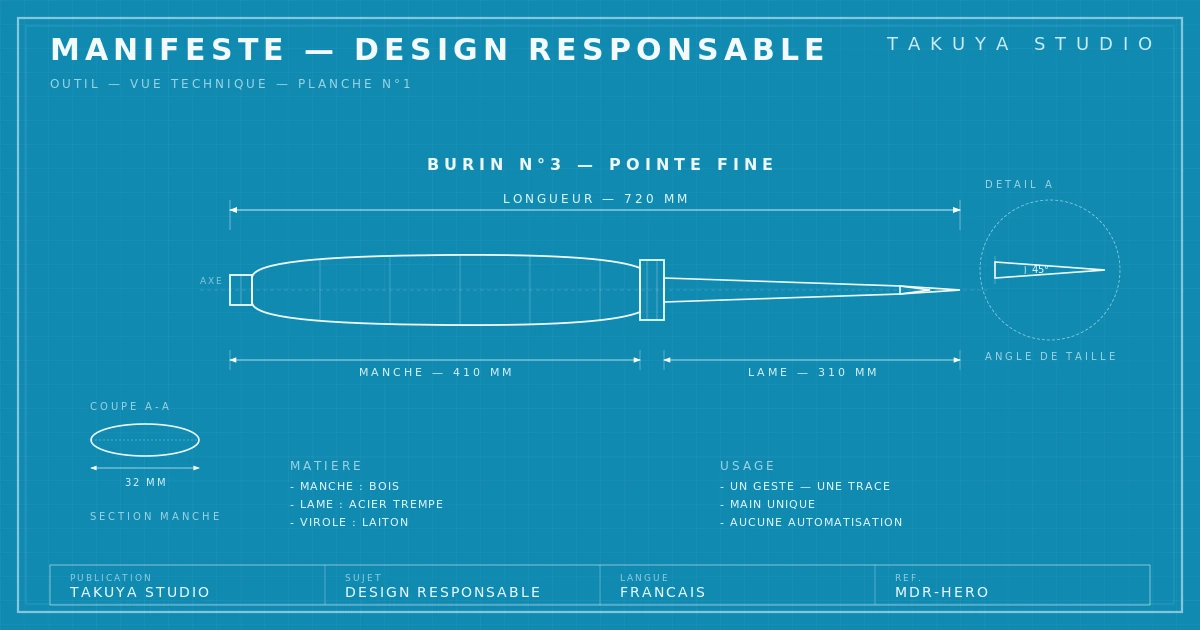
Tools don't create. They obey. The people steering them choose, cut, reject and start again, the quiet run of decisions that makes an image, at some point, come out right. Responsible design begins there, in admitting that software, a model, a brush or a pencil only extend a culture and a way of seeing.
This responsible design manifesto comes out of daily work where image meets sound, in a workshop where every delivery carries a name, a signature and someone who answers for it. Without direction, a tool produces what is politely called an average. An aesthetic average is not a style. It is the absence of one.
The most common confusion of the moment is to take ease of execution for quality of gesture. A cover, a logo or an identity is measured by how long it can carry what it stands for, and speed of production says nothing about that. A record outlives its artwork. The artwork has to earn the record.
Criteria
An image is not an average
Art is interesting only for how far it strays. Art direction means taking away as much as adding, and turning down whatever looks like everything else. That holds for a pencil line as much as for a slider in an interface. The standard has little to do with the kind of tool and everything to do with how precisely you refuse what it offers by default.
This standard is neither a luxury nor nostalgia. It is what keeps the work meaningful, for its author and for what it accompanies: an album, a label, a voice. The First Things First manifesto, in 1964 and again in 2000, made the point that a designer's skills are never neutral. They serve whatever their owner agrees to serve. Responsible work starts with that sorting.
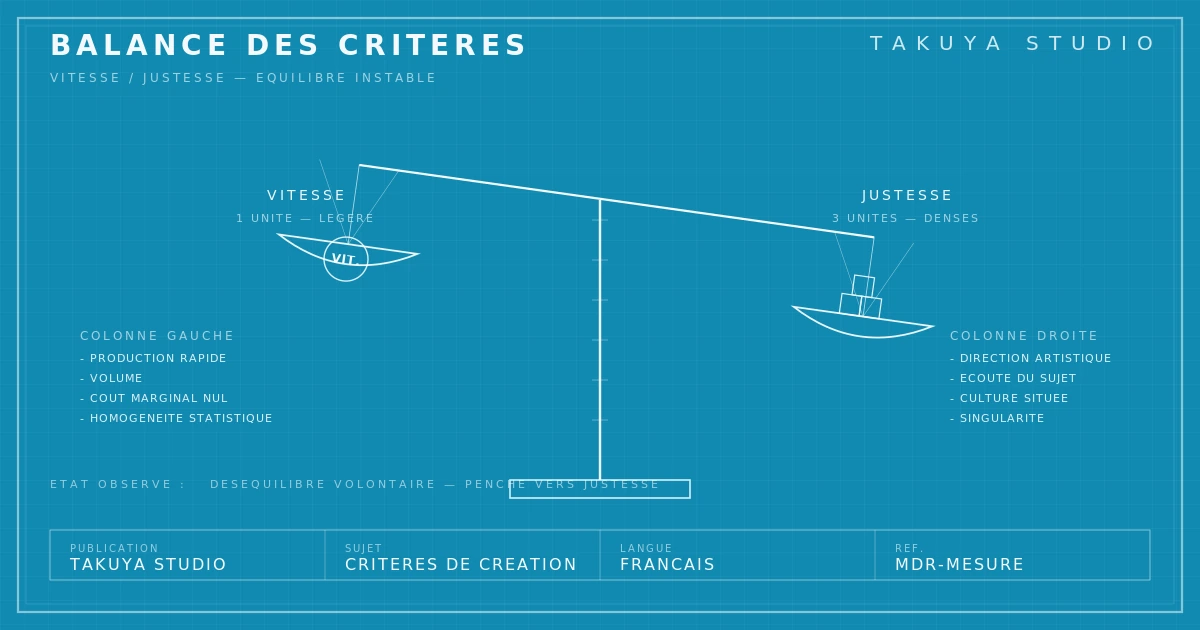
In our projects, getting it right weighs more than speed. That doesn't mean working slowly. It means settling decisions from a situated culture rather than a statistical consensus. A form kept because it suits this project, this artist, this scene: that is what we call direction.
Signature
To sign is to answer for it
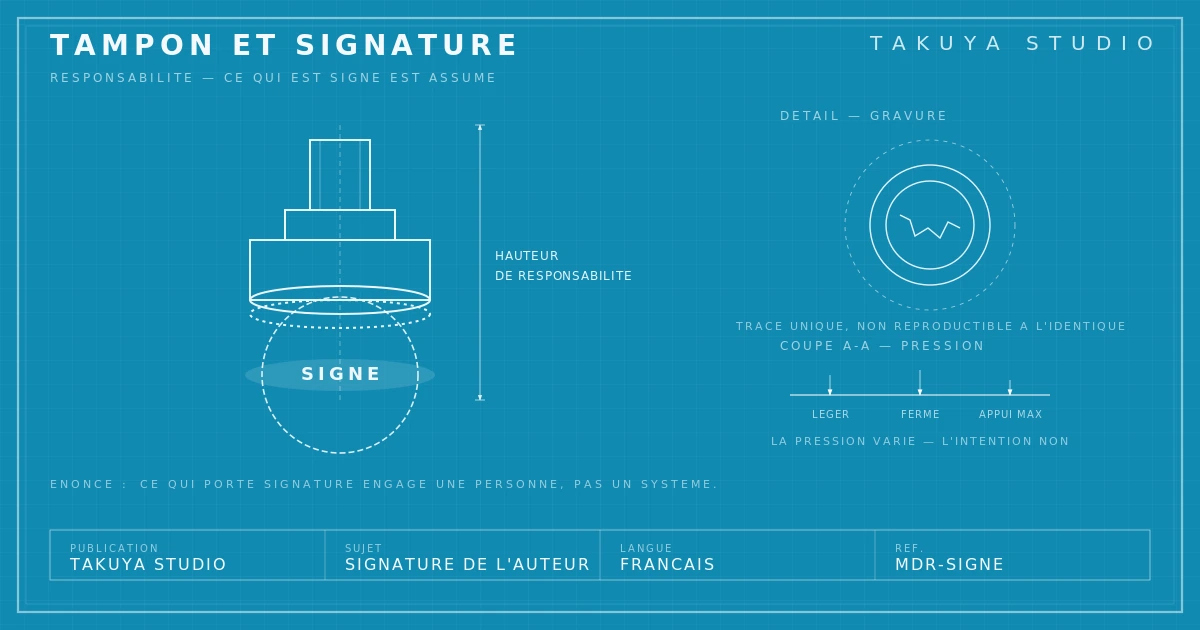
Delivering a visual means signing it, and a signature commits you. Behind a label identity there are records, artists and audiences, a chain of trust that starts with a name at the foot of the page. There is no responsible design without that awareness. What we sign, we stand behind, which means being able to account for the initial vision, the technical decisions, any compromises and the limits that were set.
A signature isn't decoration. It is where the work meets its own measure. A piece you wouldn't dare sign shouldn't leave the workshop. A signed piece, on the other hand, is open to criticism, to analysis and to time, which a good visual has to be able to withstand.
This culture of responsibility runs through the profession's own institutions. AIGA (American Institute of Graphic Arts) has documented for decades what designers owe to clients, the public and the trade. The Alliance Graphique Internationale (AGI) gathers practitioners who put their name to what they make. These bodies exist for a reason: design without a readable signature is design without readable accountability.
Time
Time as a material
Good work takes time, and the time goes into decisions more than into execution. Between two iterations you need room to look at the work and come back to it. Pure speed is an expensive illusion; what it gains in production it loses in coherence. Our projects treat that time as a material, with short cycles to iterate, pauses to judge and revisions to adjust.
No visual leaves the workshop without that slow test. Rigor doesn't rule out speed, it steers it. The question is less "how long did this take" than "was that time spent judging".
Commitments
What Takuya Studio commits to
- Sign every delivery. No visual leaves the workshop without an author who answers for it. That name is where you can come and ask questions.
- Document the choices. Each project comes with a short note: the direction taken, the major decisions, the sources of inspiration, stated plainly. The brief is treated as a document in its own right.
- Refuse the generic deliverable. A visual that could serve any project isn't a visual. We turn down requests where art direction has no room to exist.
- Own the tool, whatever it is. Technical means are chosen for each project and stated when they matter. No tool is hidden, and none excuses anyone from the artistic decision.
- Hold to the time it takes. Time to judge is part of the project, not a variable to squeeze. A deadline that leaves no time to look at the finished work is one we turn down.