
A lineage without memory
An image generated in 2026 comes out of a model that has silently read millions of works before it. It knows nothing of where it comes from. No memories, no conscious references, no masters. It produces, and what it produces sometimes resembles, loosely or exactly, what others made earlier. That resemblance isn't a citation, since the machine neither declares nor recognizes it. It's a debt with no identifiable creditor. The legal framework for AI-generated images in 2026 is starting to give the question a shape, but the law is rarely satisfied by ethical unease. It wants proof, facts, thresholds. Ethics lingers where the law runs out.
The question here isn't theft in the legal sense. It's the older and more stubborn question of artistic lineage. An artist inherits, then digests. An album cover designed today carries eighty years of modernist typography, Swiss composition, documentary photography and abstract painting. Humans know how to name that kind of debt: they cite their influences, they take the risk of homage and the risk of pastiche. A machine doesn't.
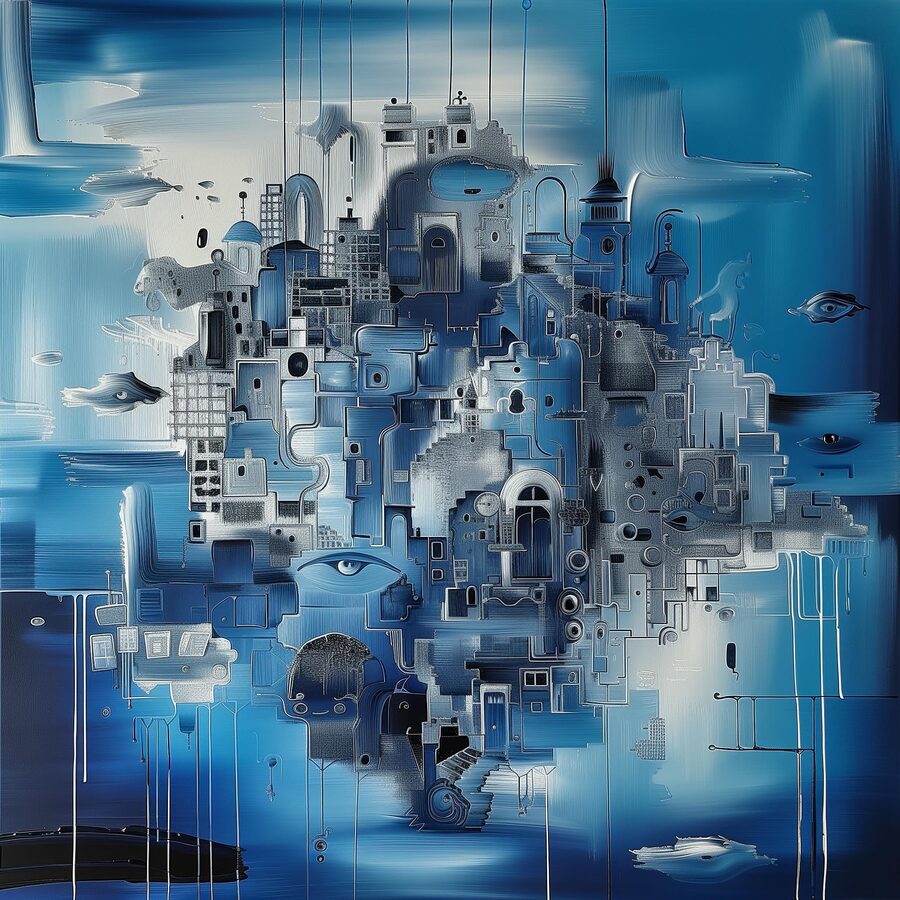
What is a putative source?
Putative means supposed, presumed, taken as such without proof. Applied to AI generation, the word describes the uncertain link between a result and whatever fed it. An image produced by a model trained on billions of works is presumably in debt to some of them. Which ones? No one can say. The model doesn't keep the images. It keeps statistical weights, vectors, numerical abstractions in which the source works have been dissolved in one enormous bath.
Dissolution doesn't erase the debt. It makes it untraceable. The sources aren't missing; they're everywhere, distributed, fragmented, unrecognizable one by one and all present together. This is a new kind of creative dependence, where the child work can't name its parents and the parents can't recognize the child. Whether that arrangement is an ethical violation or simply a change of regime in how art gets handed down is one of the more interesting blind spots of the moment.
The shadow of Walter Benjamin
In 1935, Walter Benjamin wrote that mechanical reproduction stripped the work of art of its aura, that halo of uniqueness, of presence here and now, which the photographic copy dissolved. Ninety years later, AI generation makes the symmetrical move. The generated work never had an aura, because it never had a single moment of appearance. It is multiple from the start, copyable, identical to itself in every variant. You can read this as a continuation of Walter Benjamin's essay on mechanical reproduction, or as its endpoint.
What disappears with automatic generation isn't only the aura. It's the intent of lineage. A painter quoting Velázquez knows he's quoting Velázquez. A model that turns out a composition in the manner of Saul Bass knows nothing about Saul Bass. The resemblance is a side effect, not a choice. And artistic ethics rests largely on awareness of choices: homage acknowledged, rupture owned, pastiche declared. Without awareness, the machine also deprives its user of that symbolic economy, unless the user puts it back in through the prompt, the selection, the retouching, the final assembly.
Resemblance, citation, theft: three distinct regimes
Much of the confusion in the debate comes from mixing three different regimes. Resemblance is inevitable. All new art stands in the wake of existing forms, and past a certain point no style is its inventor's exclusive property. Citation is deliberate. It borrows a motif or a signature to open a dialogue with the work cited, and it assumes the reference will be recognized. Theft is the undeclared appropriation of something distinctive enough to be recognized as someone else's mark.
AI generation drifts between these regimes without settling in any of them. An image can resemble without citing, cite without stealing, or steal without anyone being able to prove it, for lack of a traceable source. That indeterminacy makes the position of anyone creating with these tools uncomfortable, and for that reason interesting. Honesty means not running from the unease, not pretending things are clear. Collective rights bodies such as ADAGP, the French society of authors in the graphic and visual arts, are beginning to take positions, but no technical fix will replace the personal discipline of a creator who refuses the comfort of denial.
Documenting, or the informed gesture
There's no single answer to the question of putative sources. There is a possible stance: the informed gesture, aware of its debt even when it can't name it. It assumes that whoever uses a generative model holds themselves responsible for the choice of tool, the direction they give it, the selection they make among its proposals, and the work they add to the first image. It also assumes they accept the discomfort of not knowing exactly whom they owe for what they make.
Accepting this isn't absolution. It's work. Keeping a record of your prompts, naming your conscious influences, holding the most recognizable styles of living artists at arm's length, preferring owned variation to lazy mimicry: none of it solves the moral problem posed by training data, but it is the visible, controllable part of the creative act. The rest, the dissolved part, the faceless debt, still has to be thought through. Institutions concerned with digital rights and freedoms, like CNIL, France's data protection authority, in its artificial intelligence section, offer useful markers to anyone trying to hold this position without naivety.
The ethics of AI art stays open
The morality of AI generation is still unwritten. It won't be written in a declaration, a charter or an international treaty, but in the sum of individual decisions that millions of creators, labels, studios and institutions will make over the coming years. Some will say it doesn't matter, art has always been this: digested copying, inheritance acknowledged or not. Others will say that this time the scale changes the nature of the problem, and that the industrial dissolution of sources has nothing in common with influence at craft scale.
Both positions hold up. The second seems fairer to anyone watching the mechanics up close. A putative source is still a source. A debt without a creditor is still a debt. How you stand in front of the tool, with what culture, what standards, what honesty, is what will separate, in the years ahead, the work that holds from the work that collapses. For the adjacent legal and contractual issues, see our guide to AI copyright for record labels in 2026.
Bringing generative AI into a practice with judgment: More on creative AI.