
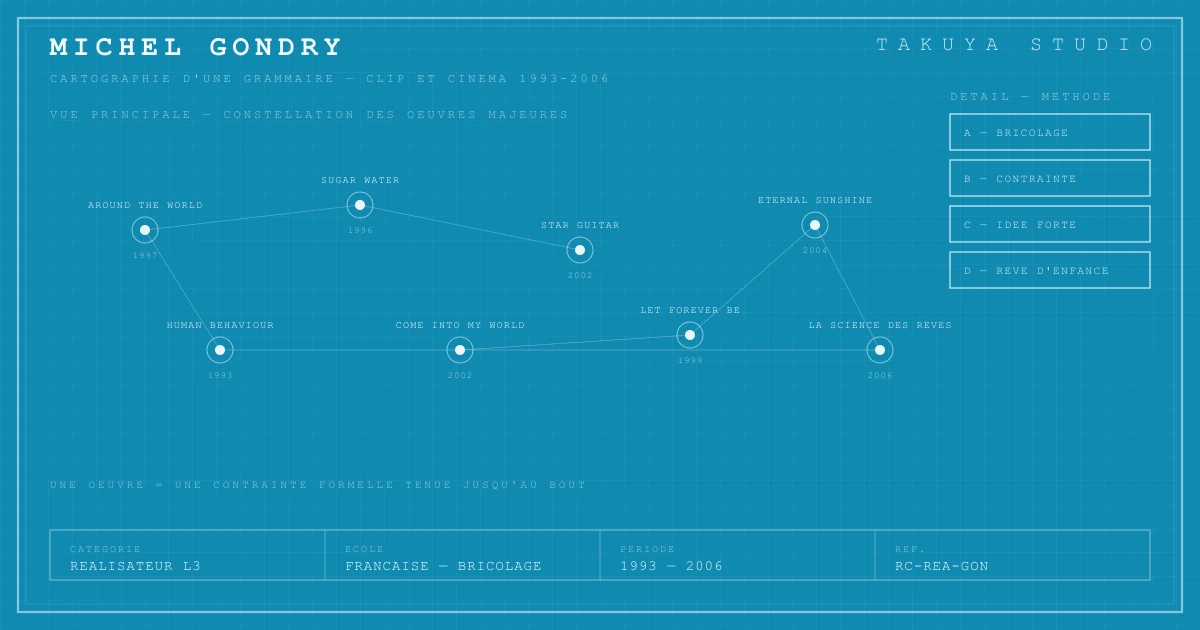
Born in Versailles in 1963, Michel Gondry holds a place of his own on the map of the great music video directors. For thirty years he turned down the easy road of digital effects and defended a craft grammar, where the formal constraint comes before the effect. His filmography begins in the late 1980s with his band Oui Oui, for whom he made his first music videos, already marked by a taste for handmade optical illusion. Björk saw one of them and in 1993 asked him for Human Behaviour, built around a mechanical teddy bear and a slow tracking shot through a papier-mâché forest. The lesson is plain from the start. The machinery of cinema can beat digital magic, as long as the idea is strong enough to hold to the end.
Mechanical illusion versus special effects
The rule in Michel Gondry's music videos: whatever could be done in post gets done on set. Sugar Water, for Cibo Matto in 1996, is the purest demonstration. The screen is split in two, one half running forward in time and the other backward, and the halves meet in the middle of the video in a kiss whose place in time is impossible to untangle. The trick was worked out before the shoot, not in the edit. The viewer can't tell where the film begins or ends, and that is exactly what the song says.
The high point comes in 2002 with Star Guitar, for the Chemical Brothers. Everything that passes the window of a moving train (pylons, buildings, bridges, signs) is synced to the sounds of the track. Gondry drew a frame-by-frame storyboard, measured the distances, went back to shoot several times. The landscape was filmed over several passes of the same journey, then assembled to fit the track. The sync holds because it was planned in advance, like a score.
One strong idea, held until it's exhausted
You recognize a Gondry piece by its starting constraint. Around the World, for Daft Punk in 1997: five groups of extras (skeletons, mummies, robots, swimmers, divers), each dancing to its own melodic line, a ballet where you see the track as much as you hear it. Come Into My World, for Kylie Minogue in 2002: a circular tracking shot in which the singer multiplies with each lap, the set filling up until the frame is saturated. Let Forever Be, for the Chemical Brothers in 1999: Busby Berkeley routines restaged in a modern apartment that opens out like a kaleidoscope.
Each of these videos follows a formal principle set on page one of the brief and kept to the final shot without compromise. No filler scenes, no lazy transitions, no shots there to pass the time. This discipline is rarer than it looks. It's what separates an auteur's music video from a variety-show clip. Every second earns its place through the central idea, not through the need to fill the running time.
Handiwork as an ethical position
The French word bricoleur, a tinkerer, someone who makes things by hand, comes up in every profile, and Gondry accepts it. For him it isn't a put-down but a claim. It stands against the industrial smoothness of the big Hollywood effects machines, against compositing that erases its own traces, against digital effects that flatten everything into the same perfection. The MoMA collection holds several of his videos for exactly that reason. They record a moment when popular moving images were still made by hand, by people you can see at work in the result.
The same approach runs through his films. Eternal Sunshine of the Spotless Mind (2004) and The Science of Sleep (2006) carry the principles of the music videos into features: cardboard sets, practical effects on set, edits with the seams showing. Gondry draws no line between noble cinema and the minor music video. It's one practice stretched across different running times and budgets, faithful to a single rule. What you see must have been made, not just computed.
A lesson for 2026
What still holds, seen from 2026, isn't a dated style. It's a method. Now that video generation is everywhere and a production company can turn out a fully synthetic music video in a few hours, Gondry's filmography is a reminder that a formal position comes before the tool. Technique serves a way of seeing. A video that looks like a thousand others is a failure of ideas, not of technology. No generative pipeline invents the starting constraint. Someone in the room has to set it, and someone, often the same person, has to hold it against everything a shoot, the clock and the budget throw at it. That's called art direction.