
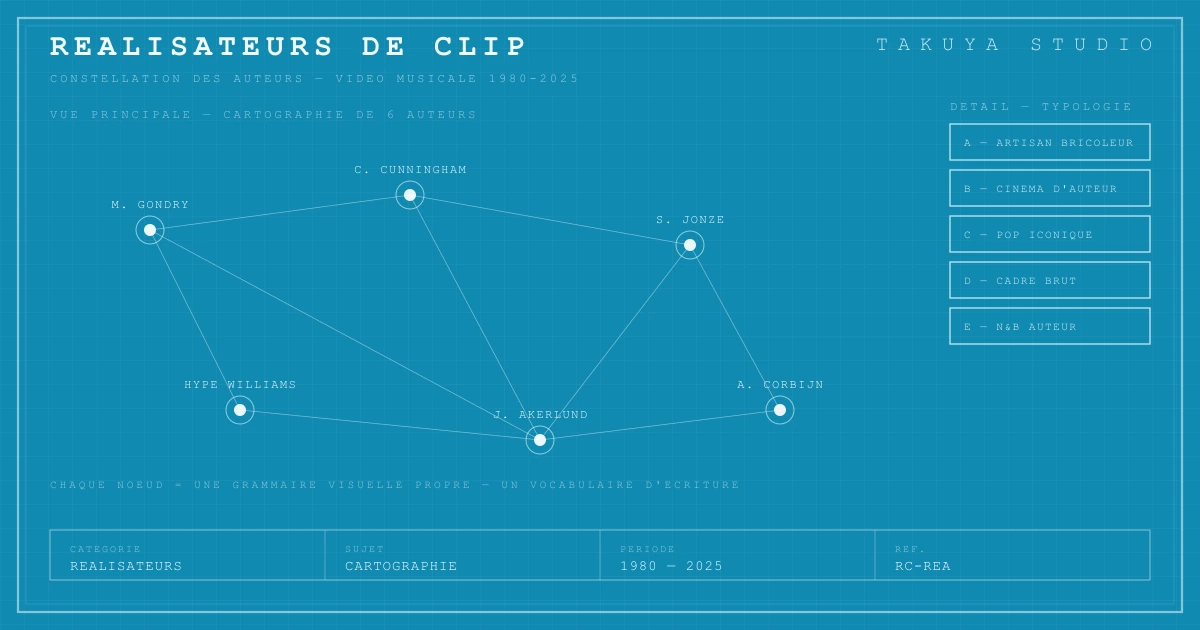
Each great music video director has a grammar of their own
The music video became a genre with recognizable auteurs. The ones who mattered didn't film to decorate the music. They extended it, contradicted it, sometimes betrayed it so it could be heard better. The craft of music video direction isn't a tool chain or a job description. Some twenty names fixed the grammar of the genre. Mapping those grammars isn't nostalgia. In 2026 it's how you know what you're quoting and what you're breaking.
The six below don't cover the whole history. They mark its sharpest edges, and each would deserve a book. What follows is a bedside note, a visual index meant to be added to.
The French school: Michel Gondry, the artisan-poet
Michel Gondry learned to film by tinkering. Björk (Human Behaviour, 1993), Daft Punk (Around the World, 1997), the White Stripes (Fell in Love with a Girl, 2002): a stance you can spot at once. Frames within frames, handmade stop-motion, effects without heavy post, the false match cut worn as a signature. His method fits in one sentence: do on set what nobody has tried yet. The economics run backwards, a tight budget producing a singularity that well-funded studios can't copy.
Gondry stands for a French school that was rarely institutionalized but spread widely among European auteurs. The concept comes first, the glossy is distrusted, and poor materials get real tenderness. You find the same sensibility in independent production, where the lack of means becomes the main argument.
The British school: Cunningham and fear, Corbijn and silence
Chris Cunningham invented a horror cinema for the music video. Come to Daddy (Aphex Twin, 1997), All Is Full of Love (Björk, 1999), Windowlicker (Aphex Twin, 1999). His images don't describe the music. They go along with it, the way a nightmare goes along with a sleeper. Distorted bodies, animatronic prosthetics and early digital rendering are tools for unease, not for showing off. He's one of the few who made the music video uncomfortable without losing the song.
Anton Corbijn, Dutch but made in London, took the opposite road. A photographer first, then a director, he documented Joy Division, Depeche Mode, U2 and Nirvana, almost always in black and white. His videos are recognizable by their visual silence: a tight frame, directional light, a rhythm that never competes with the song. It's a patient school, the opposite of the event video, and it still speaks to directors who want to film artists rather than stage them.
The American school: Jonze, Hype Williams and the music video as popular art
Spike Jonze pulled the music video toward the narrative short. Sabotage (Beastie Boys, 1994), Praise You (Fatboy Slim, 1999), Weapon of Choice (Fatboy Slim, 2000). The song becomes a pretext for a self-contained scene, close to a sketch, that could almost exist without the music. A large part of American indie music video in the 2000s comes out of this grammar, with the director as co-author of a short story and the track as its soundtrack. The risk is losing the song along the way. The gain is work people still watch twenty years later.
Hype Williams held a different line, more visual and more saturated. His videos for Missy Elliott, Busta Rhymes and Kanye West across the 1990s and 2000s fixed a good part of hip-hop's imagery: fisheye lenses, heavy color, costume as architecture, the performer staged head-on. It's a school of iconic pop that treats the video as a visual object in its own right, made to enter popular culture. The internet scattered that function without replacing it.
Jonas Åkerlund: raw aesthetics and visual pop
Jonas Åkerlund is Swedish and played drums in Bathory. He directed videos for Madonna, The Prodigy, Lady Gaga and Metallica. Smack My Bitch Up (The Prodigy, 1997) remains one of the most controversial music videos ever made, banned by several channels, shot in point of view and refusing to make its subject look good. That's his mark. The image won't be more beautiful than what it films, and the edit won't be calmer than the music. This controlled brutality became a school of its own, crossing metal, pop and electronic music without going soft. The general history of the music video locates in this tension between image and sound what sets the music video apart from the promotional film.
Mapping these six only makes sense if you accept that none of them is a model to copy. They're coordinates, landmarks in a space with many dimensions, for knowing where you stand when you make your own video. Contemporary music video work, which in France is backed by the CNC, the national film and moving-image agency, and by several funding bodies, inherits this lineage directly. Not knowing it means reinventing, clumsily, what others have already done with authority. Knowing it is where you can start getting free of it.