
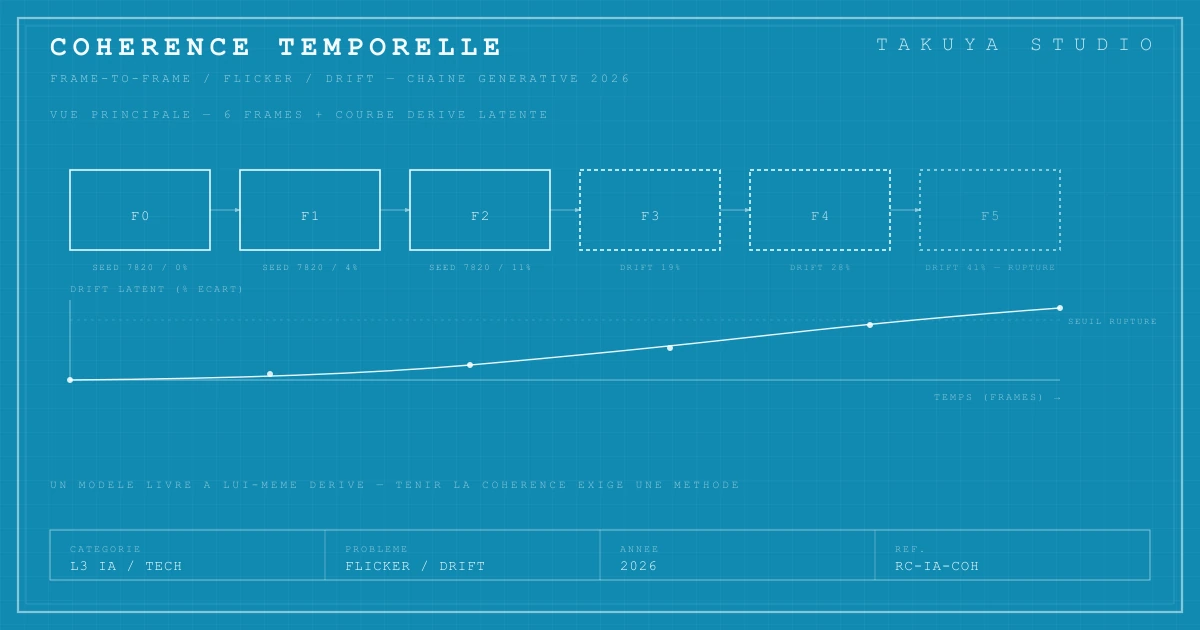
The central flaw that has kept fully generated videos from holding up over a real running time since 2022 has a name: flicker. It's the involuntary shimmer you get when a diffusion model generates each frame and lets it drift slightly from the one before. Hair changes length, skin texture crawls, the background breathes, a jacket changes its cut. This page goes further into what our status report on AI music videos in 2026 calls the problem of temporal consistency in AI video, and lays out where the methods for containing it stand in 2026. Without pretending it's solved.
Why models drift: the nature of flicker
A latent diffusion model doesn't understand its subject. For each frame, it produces a statistical sample that fits the prompt. Two neighboring frames generated independently, even with the same prompt and the same seed, will differ, because the noise fed in at the start isn't reproduced exactly. Recent video models (AnimateDiff, Kling, Hailuo, Sora) add a temporal condition, but it's only a statistical guide. It reduces drift without removing it. Consistency is excellent on short sequences, one to three seconds. Past five seconds, the drift adds up and starts to show. Andreas Blattmann and his co-authors document this in their 2023 paper on latent diffusion models for video: the latent gap between the first frame and the Nth keeps growing.
Seed drift over long sequences
A three-minute music video is twenty to fifty short shots, generated separately, sometimes from prompts that are close but not identical. Each shot depends on a seed, the random value that sets the initial noise. Leave the seeds to chance and identity, light and palette drift from one shot to the next. The singer's face changes structure between verse and chorus. The red jacket turns orange halfway through. The grain slides from imitation film to smooth digital without anyone asking. This seed drift isn't the same thing as frame-to-frame flicker. It's what separates a thirty-second viral demo from a video that holds its subject for three minutes.
The 2026 methods for containing drift
There are several levers, and none of them is enough alone. The most reliable is frame-by-frame img2img. A controlled source image (from Midjourney, or retouched by hand) conditions every frame, and drift stays contained because it's anchored to a fixed point outside the model. It's slow work, one source image for each group of matching shots, but it gives the most consistent AI videos made today. AnimateDiff, an animation module for Stable Diffusion models, adds a pre-trained temporal layer so that frames are aware of one another. It's the open-source standard for sequences of 16 to 64 frames. The proprietary tools, Kling, Hailuo and Sora, made image-reference conditioning common in 2024 and 2025: you give the model a source image, it animates it, and it holds the identity for five to ten seconds. ComfyUI lets you chain models, lock seeds and feed intermediate images back in as conditions. Serious studios keep their own reproducible workflows and carry them from one project to the next.
Post-production does its share
No generative method gets rid of flicker entirely, so part of the work moves to the edit. Optical stabilization in After Effects or DaVinci smooths out stray micro-movements. A single color grade across every sequence pulls the palette together, whichever model produced each shot. Rotoscoped masks go over the least stable areas, sometimes combined with steadier generated material, a static background replacing one that drifts. And then there's the aesthetic choice of keeping the flaw. Flicker left in on purpose and turned into expressive grain can become a signature. Several recent videos have taken that route, owning their generative origin instead of hiding it.
What it changes for whoever directs the video
In 2026, temporal consistency isn't a software feature. It's a discipline, like the one you keep on set. It gets prepared before generation (source image, seed choices, how the shots are split), checked during it (frame-by-frame review, keeping one in ten or one in fifty), and corrected afterwards in an active post-production. That's why a well-held, fully generated music video takes as much time as a conventional shoot. Generation is the automated part, perhaps five percent of the total. The other ninety-five percent are human hours of selection, matching and correction. No commercial demo shows that split. It's still the condition for a model left to itself to stop turning out the cultural average of its training data, and become the tool of an intention again.