
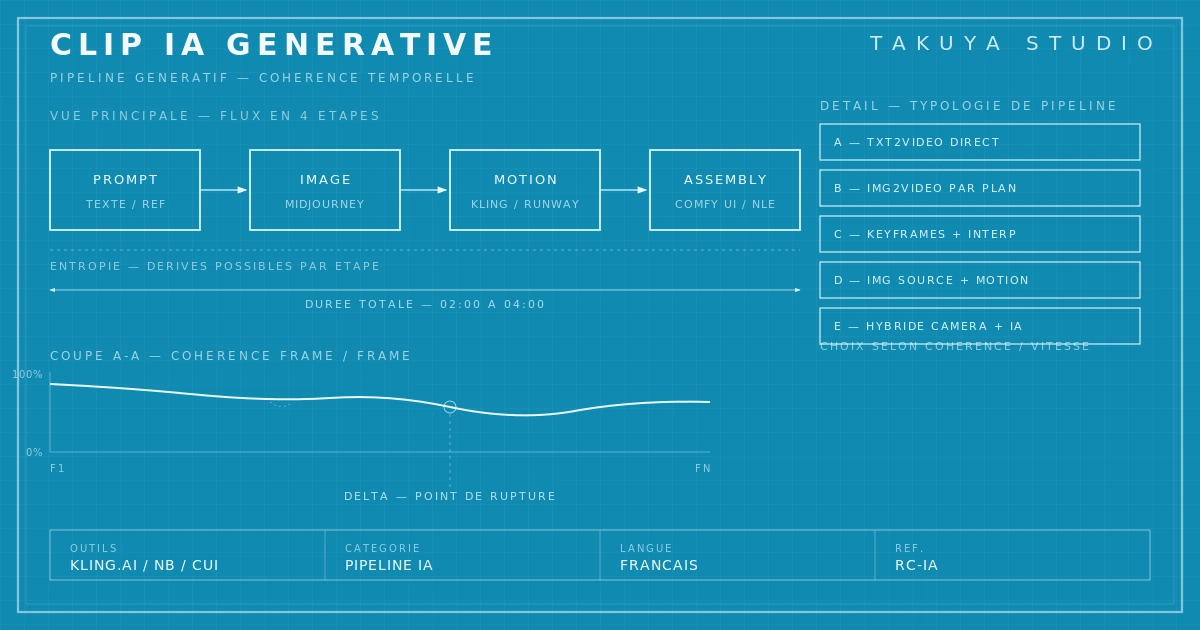
The 2026 AI music video pipeline: four tools, one unstable chain
By 2026, the chain behind an AI music video has more or less settled. Source images come mostly from Midjourney, which can hold the stylistic range of a whole visual world across hundreds of shots, and from Nano Banana for quick variations on a prompt that already works. Motion comes mostly from Kling.ai, whose video models give the most convincing character continuity on the market so far. Assembly and frame-by-frame fixes happen in ComfyUI, a visual programming environment that chains open-source models into reproducible workflows.
None of this is a recipe. The first three tools are proprietary. They get updated without warning and sometimes break overnight, when a new version shifts their aesthetic defaults. The fourth is free but asks for skills close to a developer's. The chain is the spine. The real work happens between the vertebrae, in hours of selection and correction that no commercial demo ever shows. Less a pipeline than an unstable grammar, one you learn and then unlearn every six months.
Temporal consistency, or the art of the invisible cut
The historic flaw is flicker. Each frame drifts a little from the one before: hair changes length, skin texture crawls, the background breathes, a jacket changes its cut. Le Monde described how generated video redrew the image trades in a matter of months, without outgrowing its early defects. Consistency is the line where an AI video stops being a lab experiment and becomes a piece of work that holds.
There are levers. Keyframes anchored to a source image keep a character's identity through transitions. Controlling seeds between shots lets you bring the same world back at several points in the edit. Post-production does its share: stabilization, a shared color grade, masking whatever drift remains, and sometimes a flaw kept on purpose for what it gives the image. Recent video models have made this discipline far more accessible than it was two years ago, but not automatic. Continuity is still a human intention, not a software feature. We cover it in detail on the page about flicker, drift and the 2026 methods.
Time: AI doesn't speed anything up, it moves the work
The common misunderstanding is that AI makes the work faster. It only moves the time elsewhere. A conventional shoot needs scouting, casting, logistics and three days on set. A fully AI-generated video needs hundreds of generations to sort through, corrective passes, test edits, entire days spent on prompts adjusted pixel by pixel. The keep rate usually sits somewhere between one in ten and one in fifty. None of that can be handed off.
The honest comparison is in hours of work, visible and invisible, not in calendar days or lines on an invoice. Camus saw the difference between a creator and a mere maker in the refusal of the easy way. The AI maker gets something in five minutes. The AI creator throws away forty-nine images out of fifty. The difference lies in what you demand, not in the tool, and it can't be bought now any more than it could before. That's where the professional practice of music video direction still lives in 2026. AI sits alongside the standard tools of the trade without pretending to replace them.
The question of direction: who directs it, and with what culture?
Left to itself, a latent diffusion model produces the cultural average of the images it was trained on. Smooth faces, soft light, centered composition, a palette sliding toward blue and gold. It isn't ugly. It's been seen a thousand times. Call it the models' neutral accent, a statistical weighting across a few billion public images. So the useful question is no longer what AI can do. It can do a lot, and we see it every day. The question is who directs it, with what culture, and toward what vision.
Whatever is singular doesn't live in the machine. It gets built against it, by contrast and by offset: a tight, unusual frame, a flaw left in, an unexpected reference slipped into a prompt, a post-production pass that deliberately moves away from the raw output. It's the same discipline as album covers, film title sequences or auteur photography, where a formal position comes before the tool. Technique serves a way of seeing, not the other way round. A video that looks like a thousand other AI videos is a failure of art direction, not of technology. No pipeline fixes that, and no model update will fix it tomorrow. Someone has to be in the room to decide what stays and what goes.