
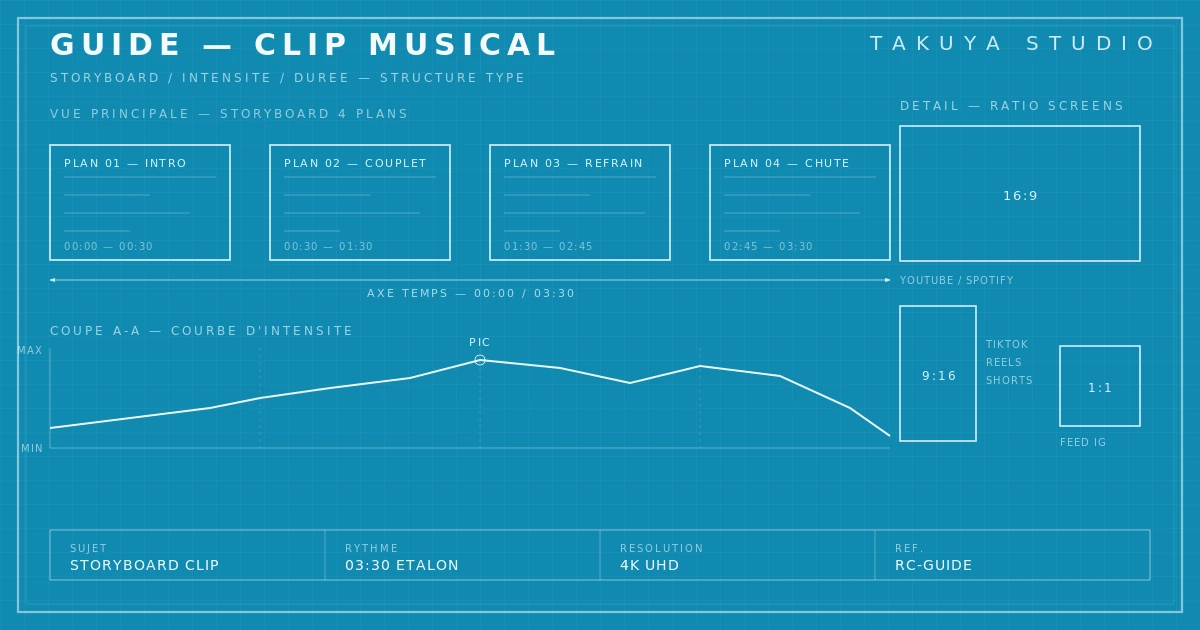
Storyboard and the standard structure of a music video
Before you make a music video, you draw it. Not in detail, and not in polished pictures. Just shots clear enough that a musician, a production manager and a camera operator all read the same thing. It's the most reliable coordination tool in the trade. A storyboard tests a breakdown before it costs anything. A scene you can't draw in four boxes rarely holds up on set.
A music video isn't built like a short film. It follows the song. A good storyboard places each shot on the musical curve: intro, first verse, the build to the chorus, the drop, the bridge, the return. Breaks in the rhythm deserve their own visual cut. The discipline is the same whether it's a five-day shoot or a video made in a bedroom by two people with a phone.
Length and pacing: intro, verse, chorus, ending
The length follows the song. Cutting the track to fit a format is a beginner's mistake. Padding it with empty stock shots is laziness. The edit follows the grammar of the genre. A long instrumental intro can afford to wait: a face in a static shot, a detail the camera stays on, a slow move. A chorus wants a tighter cut, a change of pace, something happening on screen.
Three minutes is still the standard length in 2026. Past four minutes, attention drops on most platforms. Under two, you're making a short or a teaser. The ending, the last eight to twelve seconds, deserves as much care as the opening. A video that ends badly leaves a longer aftertaste than one that started a little loosely.
Choosing a technique for the song
No technique is better than another. Live-action shooting, frame-by-frame animation, editing from archive footage, digital tools: each one suits a kind of music. A song carried by the voice often needs a patient camera, a tight frame and directional light that stays on the face. Dense electronic production can take nervous cutting, layered images, abstract graphic passages. An acoustic song rarely gains anything from being buried in effects. Minimal techno sits badly with heavy naturalism.
Art direction is the art of making that match. It's built by listening, not on a screen. A serious brief starts with ten to fifteen careful listens with no images in mind. Then references, possible techniques and constraints find their place. The studio carries this habit over from its album cover work: the form follows the sound, not the release schedule.
Formats per platform: 16:9, 9:16, 1:1, the Canvas loop
In 2026, delivering only 16:9 amounts to commercial sabotage. The horizontal master, at 1920 × 1080 or 3840 × 2160, stays the reference for YouTube and for label websites. Vertical 9:16 is for TikTok, Reels and Shorts, and gets framed on the shoot, not in a panic during the edit. Square 1:1 is for Instagram and X feeds, and cropping from the horizontal works if you left room around the subjects.
The Spotify Canvas loop runs three to eight seconds, vertical, with no audio of its own. It's neither a video nor a visualizer but a hybrid that extends the listening. The ones that work are rarely recut excerpts. They're shots designed for the loop, so that the cut from last frame to first doesn't show. One rule for every platform: a format isn't a cutdown. It's a way of writing in its own right.
Common mistakes in low-budget music videos
Shooting without a recce. Light in an apartment at 3 p.m. isn't the same room at 7 p.m., and fifteen minutes of scouting the day before saves hours of regrading. Piling on effects to make up for a small budget. Visible effects show what's missing, while restraint carries authority. Flaubert held, more or less, that a well-written page should read without the writing showing. Underestimating the mix. A soundtrack lightly compressed and rebalanced for phone speakers changes how the video is perceived more than ten rounds of image retouching.
Asking the artist to play the part they already play on stage. A music video is a different object, not a concert recording with a new frame. Saving on post-production to stretch the shoot. The opposite rule nearly always holds: fewer shots, better edited. The CNC, France's national film and moving-image agency, notes in its music video grant guidelines that the final quality depends as much on the writing and the finishing as on the shooting budget. The budget is won upstream, in the writing, not downstream by effort.
Takuya Studio makes music videos for independent artists and labels: art direction, shooting, post-production, multi-format delivery.