
The horizontal master: 16:9, YouTube and the archive
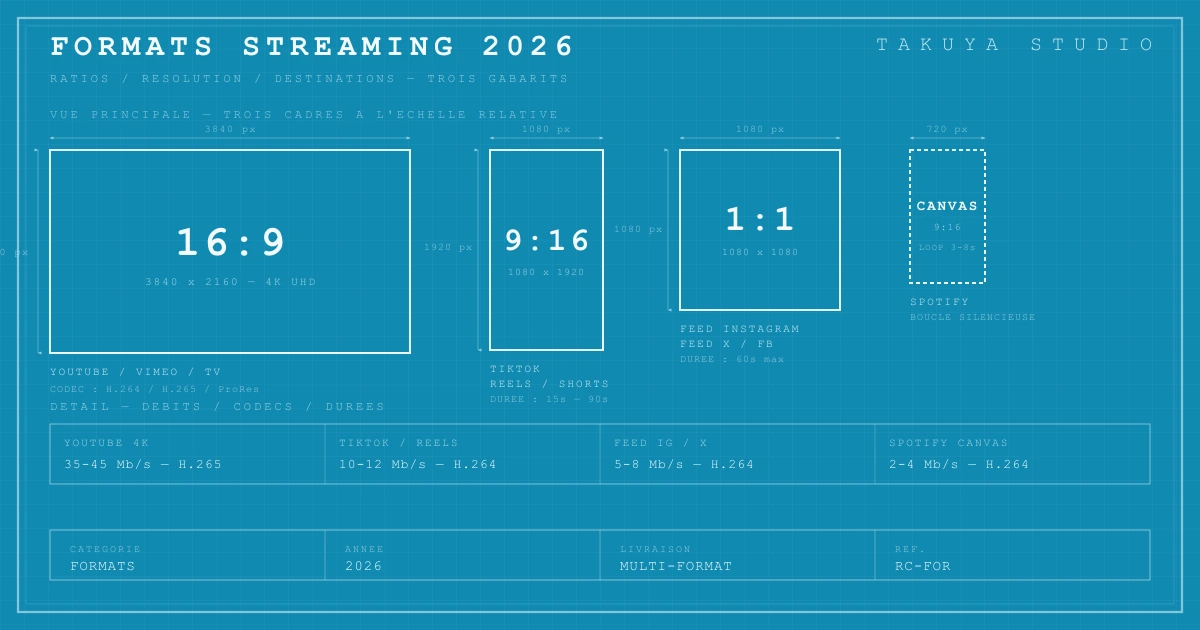
In 2026, the master of a music video is still almost always horizontal. A video made for every platform starts from a 4K UHD source at 3840 × 2160, 16:9, in ProRes 422 HQ or H.265 depending on the finishing pipeline. That master feeds every other version (vertical, square, short loops) and goes out to the main outlets: YouTube, Vimeo, TV, festivals. YouTube accepts up to 68 Mb/s in H.264, and around 35 Mb/s in H.265 for the same perceived quality. The platform re-encodes everything, but the quality of the source decides the quality after compression. What reads well in 4K reads well in 1080p. The reverse isn't true.
16:9 stays the reference because it matches the cinema screen, the television and the computer monitor, three places people still watch from, mobile or not. The YouTube blog regularly documents changes to its specs, which work as the de facto standard for long-form video.
Vertical 9:16: TikTok, Reels, Shorts
Vertical took off with TikTok and spread to Instagram Reels and YouTube Shorts. The standard spec is 1080 × 1920, H.264, at 10 to 12 Mb/s. TikTok now accepts videos up to ten minutes long, but engagement is still best under 60 seconds. Reels stop at 90 seconds, Shorts at 60. A vertical version shot on its own almost always works better than a horizontal one cropped in the edit. Cropping a 16:9 master to 9:16 throws away 56% of the picture and cuts through any composition built across the frame.
The professional rule in 2026 is to shoot, or generate, with both ratios in mind from the storyboard on. For vertical, that means subjects on the center line, backgrounds worked so they don't flatten the image, and any text kept inside the safe zone, the middle third that app interfaces won't cover. That planning is what separates a native vertical video from a horizontal one exported badly.
Square 1:1: Instagram, X and Facebook feeds
The historic Instagram feed format still has its uses for trailers, teasers and short excerpts posted across X and Facebook. The spec is 1080 × 1080, 60 seconds max per post, H.264 at 5 to 8 Mb/s. Unlike 9:16, which needs reframing, 1:1 survives a crop from a 16:9 master better than you'd expect, as long as enough room was left around the central subjects during the shoot.
Square gets neglected because it sits between viral vertical and reference horizontal. Yet that's where the excerpts fans repost end up circulating: highlights pulled out of the narrative, living on feeds with a viral logic of their own.
Spotify Canvas: the silent loop
Three to eight seconds, 9:16, 720 × 1280, H.264 at 2 to 4 Mb/s, no audio track of its own. The Canvas loops silently while the song plays. It isn't there to tell a story. It extends the listening with a visual signal that fits. Spotify's official documentation recommends treating the Canvas as a native visual loop, not as an excerpt.
The Canvases that work have a first and last frame that match with no visible jump. That takes either cyclical motion (a face turning away and back, an object rotating) or motion hidden at the cut point, behind a dissolve or a graphic transition. A badly made Canvas jumps every eight seconds, and the flaw breaks the spell.
YouTube chapters and the radio edit: the extended delivery
YouTube chapters, set in the video description, show up as clickable markers. For a music video they're only useful on long versions: a director's cut, a behind-the-scenes piece, an extended cut with an interview. On a three-minute main video, which needs to be watched in one go, they're useless or worse. On a fifteen-minute compilation or a live film, they make navigation easy.
A professional multi-format delivery in 2026 usually includes the 4K 16:9 ProRes archive master, a 1080p H.264 file for YouTube, a native 9:16 version for TikTok and Reels, a 1:1 version for feeds, the Canvas loop if requested and, sometimes, a 1080p H.264 MP4 at reduced bitrate (5-6 Mb/s) for music distributors with their own constraints (Audiomack, SoundCloud Pulse, some majors). In France, the CNC, the national film and moving-image agency, now includes multi-format delivery among the criteria for its music video grants. A funded video has to live on every current platform, not just YouTube.